
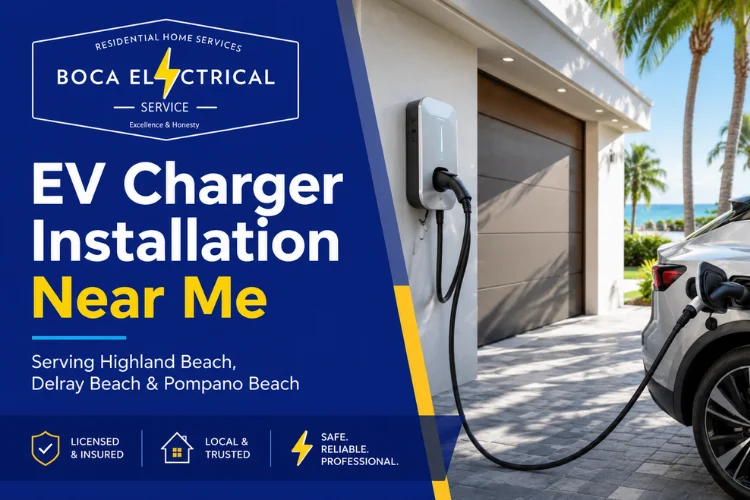
As more homeowners switch to electric vehicles, having a reliable charging setup at home is becoming less of a luxury and more of a daily convenience. If you have been searching for “EV charger installation near me” in Highland Beach, Delray Beach, Pompano Beach, Boca Raton, or nearby South Florida areas, the first step is making sure your home’s electrical system is ready.
A home EV charger is not just another outlet. It often requires the right circuit, proper wiring, load calculation, panel capacity check, and safe installation by a qualified electrician. Level 2 home chargers typically use 240V power and charge much faster than a standard Level 1 cordset. The U.S. Department of Energy notes that EV owners can use Level 1 charging or install Level 2 charging equipment at home for faster charging.
Why Install a Home EV Charger?
Public charging stations are helpful, but they are not always convenient. A home EV charger lets you plug in overnight, start each day with more range, and avoid waiting at public charging locations.
For many homeowners, the biggest benefits include:
- Faster charging compared to a regular wall outlet
- More convenience for daily driving
- Better control over your charging schedule
- Reduced dependence on public charging stations
- Added home value and future-ready electrical infrastructure
ENERGY STAR notes that Level 2 chargers are generally more efficient than Level 1 charging and can add significantly more miles of range per hour of charging.
Level 1 vs. Level 2 EV Charging
Most electric vehicles come with a Level 1 charger that plugs into a standard 120V outlet. This can work for light drivers, but it is often slow.
A Level 2 EV charger is the better option for many homeowners because it uses a 240V circuit and charges much faster. This is especially useful if you drive daily, own a long-range EV, or want your vehicle ready by morning.
Before installing a Level 2 charger, an electrician should check:
- Your electrical panel capacity
- Available breaker space
- Existing wiring condition
- Distance from panel to charger location
- Whether your home needs a panel upgrade
- Proper grounding and code compliance
- Indoor or outdoor installation requirements
Do You Need a Panel Upgrade for an EV Charger?
Not always. Some homes already have enough electrical capacity for a Level 2 EV charger. Others may need a panel upgrade, subpanel, load management device, or dedicated circuit adjustment.
This is why a proper electrical evaluation matters. Adding an EV charger without checking your panel load can create safety issues, nuisance breaker trips, overheating risks, or failed inspections.
If your home already has large electrical loads like a pool heater, spa, air conditioning system, electric range, dryer, or whole-home battery backup, your panel should be reviewed before adding another major load.
EV Charger Installation in Highland Beach
Highland Beach homeowners often have condos, townhomes, luxury residences, and coastal properties with unique electrical layouts. Some properties may also involve HOA or condo association approvals before work begins.
For homes near the water, proper installation is especially important because outdoor equipment may be exposed to salt air, humidity, rain, and heat. Your EV charger should be installed in a safe, accessible location using equipment rated for the environment.
EV Charger Installation in Delray Beach
If you live in Delray Beach, a home EV charger can make daily driving much easier, especially if you commute, work from home, or frequently travel around Palm Beach County.
Delray Beach also uses a digital permitting process where documents, payments, and permits can be handled online through the city’s system. Because permit requirements can vary depending on the scope of work, it is best to have a qualified electrician review your project before installation.
EV Charger Installation in Pompano Beach
For Pompano Beach homeowners, EV charger installation should be planned around your home’s panel capacity, charger location, parking setup, and local code requirements.
If your charger will be installed outdoors, near a driveway, or in a garage exposed to moisture, your electrician should confirm that the charger, wiring, mounting, and protection are appropriate for the location.
Where Should You Install Your EV Charger?
The best location depends on where you park and how your electrical system is set up. Common installation areas include:
- Garage wall
- Driveway side wall
- Carport
- Exterior wall near parking area
- Dedicated post or pedestal
- Condo or assigned parking space, when approved
The shorter the distance from the electrical panel to the charger, the simpler the installation may be. Longer wiring runs, trenching, concrete work, outdoor mounting, or panel upgrades can increase the scope of the project.
Why You Should Not DIY an EV Charger Installation
Installing a Level 2 EV charger is not the same as plugging in a regular appliance. It may require a dedicated circuit, breaker sizing, load calculation, proper wiring, grounding, GFCI protection, and permit compliance.
A poor installation can lead to:
- Overloaded circuits
- Breaker trips
- Damaged charger equipment
- Fire hazards
- Failed inspections
- Insurance issues
- Costly repairs later
For safety, your EV charger should be installed by a qualified electrician who understands residential electrical systems and local code requirements.
Our EV Charger Installation Process
At Boca Electrical Service, we make the process simple for homeowners in Highland Beach, Delray Beach, Pompano Beach, Boca Raton, and nearby South Florida communities.
Our process includes:
- Home Electrical Evaluation
We check your panel, breaker space, wiring, and charger location. - Charger Placement Planning
We help determine the safest and most practical location for your EV charger. - Circuit and Load Review
We review whether your home can safely support the added electrical demand. - Installation
We install the wiring, breaker, and EV charger connection based on your home’s needs. - Safety Testing
We verify that the charger is operating properly and that the installation is safe. - Clean Finish
We keep the installation neat, secure, and ready for daily use.
Common Signs Your Home Needs an Electrical Review First
Before installing an EV charger, schedule an electrical evaluation if you notice:
- Your panel is old or full
- Breakers trip often
- Lights flicker when large appliances turn on
- You recently added a pool, spa, or major appliance
- Your home still has outdated wiring
- You are unsure whether your panel is 100 amp, 150 amp, or 200 amp
- You want to install a Level 2 charger outdoors
These signs do not always mean you cannot install an EV charger, but they do mean your system should be checked first.
EV Charger Installation Near Me
When homeowners search for “EV charger installation near me,” they are usually looking for a local electrician who can respond quickly, understand the area, and install the charger safely.
Boca Electrical Service proudly serves:
- Highland Beach
- Delray Beach
- Pompano Beach
- Boca Raton
- Deerfield Beach
- Boynton Beach
- Lighthouse Point
- Nearby South Florida communities
Whether you already purchased a charger or need help choosing the right setup, our team can inspect your electrical system and recommend the safest installation option.
FAQs About Home EV Charger Installation
How much does EV charger installation cost?
The cost depends on your charger type, panel condition, wiring distance, permit requirements, and whether upgrades are needed. A simple garage installation may cost less than an outdoor installation that requires a longer wiring run or panel work.
Do I need a Level 2 EV charger at home?
If you drive regularly and want faster charging, a Level 2 charger is usually the better choice. Level 1 charging can work for low-mileage drivers, but it is much slower.
Can I install an EV charger outside?
Yes, many EV chargers can be installed outdoors, but the unit and installation must be rated for exterior use and protected properly from weather exposure.
Do I need a permit for EV charger installation?
In many cases, electrical work for an EV charger may require a permit, especially when adding a new circuit or making changes to the electrical panel. Requirements depend on your city, county, and project scope. Palm Beach County, for example, provides online permit application access through its ePZB portal for applicable building permits in unincorporated areas.
Can my current electrical panel handle an EV charger?
It depends on your panel size, existing electrical load, available breaker space, and the charger requirements. An electrician should inspect your panel before installation.
Schedule EV Charger Installation in Highland Beach, Delray Beach or Pompano Beach
Ready to install a home EV charger? Boca Electrical Service can help you choose a safe location, check your electrical capacity, and install your charger properly.
Call Boca Electrical Service today at (561) 320-8539 to schedule your EV charger installation in Highland Beach, Delray Beach, Pompano Beach, Boca Raton, or nearby South Florida areas.