
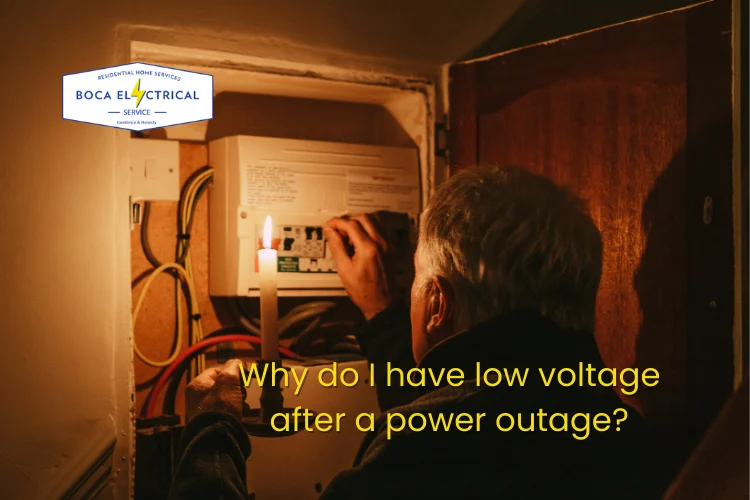
Low voltage after a power outage means your home may not be receiving full, stable power on one or more circuits. The cause may be a utility voltage problem, a partially tripped breaker, an overloaded circuit, a damaged service connection, or a loose neutral. Some causes are temporary, but others can damage appliances or create a fire risk.
If lights remain dim for an extended period, turn off major appliances and contact Florida Power & Light (FPL). If only certain rooms are affected, breakers repeatedly trip, or you notice buzzing, warmth, burning odors, or uneven light brightness, contact a licensed electrician immediately.
| Call for urgent help when: Some lights become unusually bright while others are dim, you smell burning, hear buzzing or crackling, see discoloration, feel heat at an outlet or panel, or experience repeated breaker trips. Turn off major loads and avoid opening the electrical panel. |
Quick Diagnosis: What Are You Seeing?
| What You Notice | Possible Cause | What to Do |
|---|---|---|
| Dim lights throughout the house | Utility brownout, voltage fluctuation, or service issue | Turn off major appliances, ask whether neighbors are affected, and contact FPL. |
| Only one room or circuit is affected | Partially tripped breaker, loose connection, damaged breaker, outlet, or branch-circuit wiring | Stop using the affected circuit if there is heat, odor, noise, or discoloration. Schedule electrical troubleshooting. |
| Some lights are bright while others are dim | Possible loose or damaged neutral connection | Treat this as urgent. Turn off sensitive electronics and major appliances, then call FPL or a licensed electrician. |
| Lights dim when the AC or another large appliance starts | Circuit overload, voltage drop, weak connection, or service-capacity problem | Reduce the load temporarily. Arrange an inspection if the problem continues. |
| Half the home has weak or no power | Lost service leg, main breaker issue, damaged service connection, or utility problem | Contact FPL and an electrician. Avoid running 240-volt appliances. |
| Buzzing, burning odor, warm outlet, or warm panel | Loose or overheating electrical connection | Stop using the affected area and request urgent electrical service. |
What Does Low Voltage Mean in a House?
Most homes in the United States receive 120/240-volt electrical service. In Florida, utilities normally operate standard 120-volt service within approximately 114 to 126 volts. A short fluctuation can occur while power is being restored, but voltage that remains low, changes significantly from room to room, or drops whenever an appliance starts should be investigated.
A plug-in voltage meter can provide a preliminary reading, but it cannot identify the cause. Do not remove the electrical panel cover or touch service equipment to test voltage yourself.
Why Are My Lights Dim After a Power Outage?
Dim lights are one of the most noticeable signs that power has returned without becoming fully stable. The pattern of dimming can help narrow down whether the issue is outside the home or within the electrical system.
1. Utility Brownout or Voltage Fluctuation
After a storm or outage, the utility may restore power while the local electrical system is still stabilizing. Lights may remain dim across the entire house, and neighbors may experience the same problem. FPL advises customers to turn off major appliances and report the problem when lights stay dim for an extended period.
2. Loose or Damaged Neutral Connection
A neutral conductor provides the return path for many 120-volt circuits. When the neutral connection is loose or damaged, voltage can become uneven. One group of lights may become brighter while another becomes dimmer. Electronics may behave unpredictably, and appliances can be exposed to abnormal voltage.
| Loose-neutral warning Bright and dim lights occurring at the same time are more concerning than ordinary flickering. Stop using major appliances and seek professional help immediately. |
3. Partially Tripped or Damaged Breaker
A breaker can trip internally while its handle appears close to the ON position. This may affect one room, one appliance, or several outlets on the same circuit. A power restoration event can also expose an aging or damaged breaker that no longer maintains a reliable connection.
4. Loose Connection in the Panel, Outlet, or Circuit
Power loss and restoration can place stress on already weak electrical connections. Warning signs include intermittent power, buzzing, heat, discoloration, or a burning smell. Loose connections inside an electrical panel should never be tightened as a do-it-yourself repair.
5. Overloaded Circuit When Power Returns
When power returns, the air conditioner, refrigerator, water heater, chargers, and other equipment may restart at nearly the same time. This sudden demand can cause temporary dimming. Persistent dimming may indicate an overloaded circuit, excessive voltage drop, a weak connection, or insufficient service capacity.
6. Lost Service Leg or Partial Power
A typical home receives two 120-volt service legs. If one leg is interrupted, part of the home may lose power while other areas continue working. Some 240-volt appliances may not operate correctly. The problem may be at the utility transformer, service drop, meter equipment, main breaker, or service conductors.
How to Check the Problem Safely
Use observation rather than disassembly. These steps can help you describe the problem to FPL or an electrician without exposing yourself to energized equipment.
- Check whether the entire home is affected or only certain rooms, lights, and outlets.
- Ask a nearby neighbor whether their lights are also dim or unstable.
- Turn off large loads such as the air conditioner, electric dryer, oven, pool equipment, and EV charger while voltage appears unstable.
- Check whether a GFCI outlet has tripped in the kitchen, bathroom, garage, laundry area, or exterior.
- Look at breaker handles without removing the panel cover. A tripped breaker may sit between ON and OFF.
- If there are no signs of overheating or damage, reset an affected branch-circuit breaker once by moving it fully to OFF and then back to ON.
- Write down which rooms are affected and whether the problem changes when a major appliance starts.
- Use a plug-in voltage meter only if you are comfortable doing so. Test more than one outlet and record the readings.
| Do not continue resetting a breaker If a breaker will not reset, trips again, feels hot, produces noise, or the low-voltage condition remains, leave it off and call a licensed electrician. Never remove the panel cover for homeowner troubleshooting. |
When Should I Call FPL vs. an Electrician?
Call FPL when:
- The entire house remains dim or power quality is unstable across many circuits.
- Nearby homes are experiencing the same problem.
- You see damage near the overhead service line, transformer, meter area, or utility equipment.
- Lights stay dim or bright for an extended period after power is restored.
- Your UPS or voltage monitor repeatedly reports a power-quality problem across the home.
Call a licensed electrician when:
- Only certain rooms, outlets, or circuits are affected.
- Some lights brighten while others dim.
- Breakers trip repeatedly, will not reset, or appear damaged.
- You hear buzzing, crackling, popping, or sizzling from the panel, an outlet, or a switch.
- An outlet, switch, breaker, or panel feels warm or shows discoloration.
- You smell burning insulation or notice smoke or sparking.
- Appliances remain underpowered even after the utility confirms normal service.
Can Low Voltage Damage Appliances?
Yes. Low or unstable voltage can place extra stress on equipment with motors, compressors, circuit boards, and power supplies. Air conditioners, refrigerators, freezers, pool pumps, microwaves, computers, televisions, and smart-home equipment may malfunction or overheat when voltage is outside their expected operating range.
Until the problem is resolved, turn off major appliances and unplug sensitive electronics when it is safe to do so. Do not keep restarting equipment that is humming, cycling, or failing to operate normally.
What Electricians Check During Low-Voltage Troubleshooting
A licensed electrician can determine whether the problem begins at the utility service, electrical panel, branch circuit, or a specific device. The inspection may include:
- Incoming voltage on both service legs
- Neutral connections, grounding, and bonding
- Voltage drop while the circuit is under load
- Main breaker and branch-circuit breaker condition
- Loose, damaged, or overheated connections
- Panel bus bars and service equipment
- Affected outlets, switches, and junction points
- Appliance circuits and other high-demand loads
Sharing a list of affected rooms, appliance behavior, voltage readings, and the time the problem started can make the diagnosis faster.
How to Reduce Problems After Future Outages
- Install whole-home surge protection to reduce damage from voltage spikes. Surge protection does not correct low voltage, but it can add protection when power is interrupted or restored.
- Use quality point-of-use surge protectors for computers, televisions, networking equipment, and other sensitive devices.
- Have older panels, breakers, grounding, and service connections inspected for heat damage, corrosion, or wear.
- Avoid restarting all major appliances at the same time after an outage.
- Consider voltage monitoring for critical appliances such as refrigerators, freezers, HVAC systems, and pool equipment.
- Report recurring dimming or brightening to FPL instead of treating it as normal.
Still Experiencing Dim Lights or Low Voltage?
If your lights remain dim, only part of your home has power, or your electrical system behaves unusually after an outage, Boca Electrical Service can inspect your panel, breakers, service connections, circuits, and wiring.
Our licensed electricians provide electrical troubleshooting and urgent repairs for homeowners in Boca Raton and nearby Palm Beach County and Broward County communities.
| Call Boca Electrical Service at (561) 320-8539 to schedule electrical troubleshooting. |
Why are my lights dim after the power came back on?
The utility system may still be stabilizing, or your home may have a breaker, service connection, neutral, or circuit problem. If the entire home is affected, turn off major appliances and contact FPL. If only certain rooms are affected, call an electrician.
Why does only part of my house have power after an outage?
Partial power can result from a tripped breaker, a lost service leg, a damaged main breaker, a service connection problem, or a utility issue. Avoid operating 240-volt appliances until the cause is identified.
Why do my lights dim when the air conditioner turns on?
A brief, minor dip may happen when a large motor starts, but noticeable or persistent dimming can indicate an overloaded circuit, excessive voltage drop, a weak connection, or a service-capacity issue.
Why are my lights dim even though no breakers are tripped?
Low voltage is often caused by a supply or connection problem rather than an overload or short circuit. A breaker may also be internally tripped or damaged even when its handle does not look fully tripped.
Why are some lights brighter while others are dim?
This pattern can indicate a loose or damaged neutral connection. Because abnormal voltage may damage appliances or overheat wiring, turn off major loads and contact FPL or an electrician immediately.
Is 105 volts safe after an outage?
A brief low reading may occur during restoration, but voltage that remains near 105 volts is outside FPL’s normal 114-to-126-volt range for a standard 120-volt service. Turn off major appliances and report the condition.
Could the utility transformer be causing the problem?
Yes. A damaged transformer or distribution problem can affect several homes. When neighbors have the same symptoms, report the problem to FPL.
Should I reset the main breaker?
Do not repeatedly operate the main breaker or remove the panel cover. Homeowners may reset an affected branch breaker once when there are no signs of heat, burning, buzzing, or damage. Call an electrician if the problem continues.
Will a whole-home surge protector fix low voltage?
No. A surge protector helps reduce high-voltage spikes but does not correct low voltage, a loose neutral, a damaged breaker, or a utility supply problem.
Who should I call first: FPL or an electrician?
Call FPL when the whole home or nearby houses are affected. Call an electrician when the problem is limited to certain rooms or circuits, or when you notice uneven brightness, repeated breaker trips, buzzing, heat, discoloration, or burning odors.
In short
Dim lights or low voltage after a power outage may come from the utility supply, a breaker, an overloaded circuit, a loose connection, or a neutral problem. Whole-home dimming generally points toward the utility, while problems limited to certain rooms more often require an electrician. Uneven bright and dim lights, heat, buzzing, burning odors, or repeated breaker trips should be treated as urgent warning signs.