
| Quick takeaway: For most standard ceiling fans, use counterclockwise rotation in summer for a downdraft. If the issue involves wiring, a loose mounting bracket, unusual sounds, or repeated breaker trips, stop DIYing and call a licensed electrician. |
Fan direction during summer is one of the simplest checks South Florida homeowners can make to improve comfort and reduce unnecessary cooling demand, yet many homeowners run their ceiling fans all season without ever confirming the blades are spinning the right way. The team at Boca Electrical Service hears from homeowners in Boca Raton, Delray Beach, and Pompano Beach who are uncomfortable despite running their fans at full speed. A common reason is that the fan is spinning in the wrong direction, working against comfort instead of for it. This article covers why direction matters, how to fix it yourself in minutes, the exceptions to the standard rule, and the warning signs that tell you to put the ladder away and call a licensed electrician. If your fan needs more than a direction change, see our ceiling fan services in Boca Raton for installation, wiring, replacement, and troubleshooting support.
Why fan direction during summer changes how cool you feel
A ceiling fan set to spin counterclockwise, viewed from below, pushes air straight down toward the people in the room. That moving air accelerates sweat evaporation from your skin, which creates a wind-chill effect. The room’s actual temperature does not drop; your perceived temperature does. In South Florida’s summer humidity, even a modest improvement in perceived comfort can make a noticeable difference.
The blade angle is what makes counterclockwise ceiling fan rotation work. Each blade is pitched to scoop air and drive it downward, creating a column of moving air underneath the fan – a downdraft. Stand under it and you should feel the moving air immediately. This is the effect you are looking for during summer.
Using a ceiling fan correctly can also help you stay comfortable at a higher thermostat setting. Florida Power & Light (FPL) says a ceiling fan can make people feel up to about 3°F cooler, which may allow you to raise the thermostat a few degrees without sacrificing comfort. FPL also notes that each degree you raise the thermostat above 75°F can save up to 5% on monthly cooling costs, depending on your home and A/C system. The important catch is that ceiling fans cool people, not rooms, so turn the fan off when no one is in the room.
How to check fan direction during summer
The visual check is simpler than most people expect. Stand directly under the fan, turn it on at medium speed, and watch the blade tips. When viewed from below, counterclockwise rotation appears as the blades moving from your right toward your left across the front of the fan. That is the typical summer setting. If the motion goes the other way, the fan may need to be reversed.
Not sure what you are seeing? Use the feel test. If you feel a direct breeze pushing down on you, the seasonal fan setting is doing what you want. If you feel little airflow, or feel air being pulled upward around you, the fan may be in winter mode, circulating air near the ceiling rather than driving a breeze down to where you are standing.
Changing the direction: which method works for your fan type
Using the reverse fan direction switch
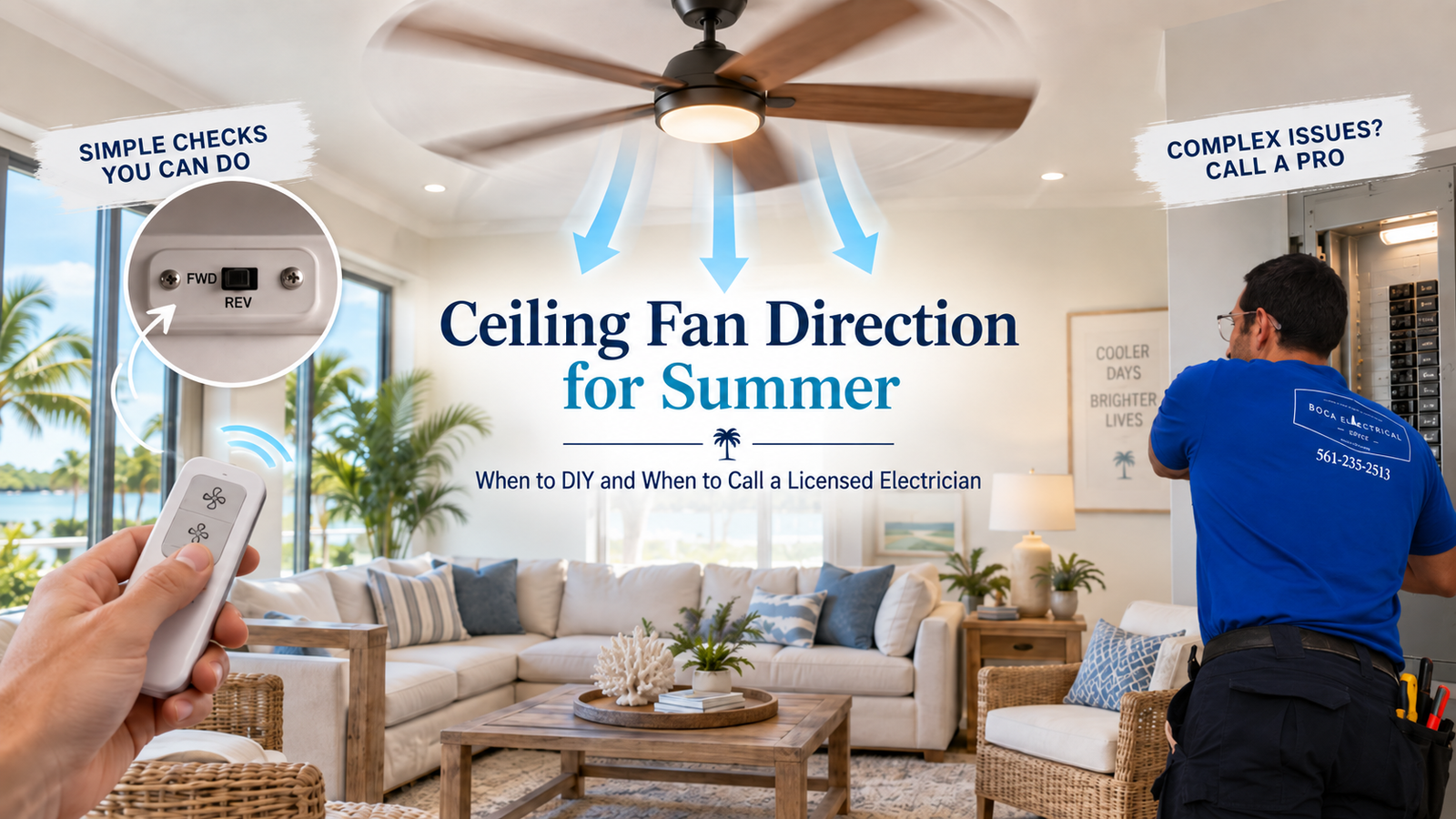
For most standard ceiling fans, the fix takes about 60 seconds. Turn the fan completely off and wait for the blades to stop spinning. Then look for a small slide switch on the side of the motor housing – the cylindrical part between the blades and the ceiling – and flip it to the opposite position. Turn the fan back on and confirm the airflow. That is the whole process for many fans installed in South Florida homes.
Many modern fans include a direction button on the handheld remote. Some remotes require you to hold the button until the fan light blinks to confirm the change. Pull-chain fans rarely have a dedicated chain for direction control; the actual change usually still happens at the motor housing switch, which you access only after turning the fan off.
One common frustration is not being able to find the switch because the fan canopy, the decorative cover that sits against the ceiling, is blocking access. If the fan needs to be partially dismounted to reach the control, turn off the circuit breaker first. If dismounting involves disconnecting wiring or manipulating the mounting bracket, call a licensed electrician rather than improvising.
Smart ceiling fans may handle direction changes through the manufacturer’s app or a compatible voice assistant. Hunter, Minka-Aire, and similar brands often expose a direction toggle in their apps, usually labeled as summer or winter mode. The app may run through a stop-then-reverse sequence automatically or prompt you to turn the fan off first. If your fan is being integrated with switches, automation, or other LED and smart controls, proper wiring and device compatibility matter. That is where a licensed electrician can prevent control problems and unsafe connections.
When counterclockwise isn’t the right summer setting
When the downdraft doesn’t reach occupants
The counterclockwise rule works well for most rooms, but not every room behaves the same way. On very high or vaulted ceilings, the downdraft from counterclockwise rotation can lose momentum before it reaches the people below. In some spaces, a lower fan speed or a different setup may circulate air more comfortably. The practical test still applies: stand in the occupied area and judge whether you actually feel useful airflow.
Dining rooms are another specific case. Counterclockwise at high speed can create a strong downward draft that blows napkins, cools food faster than most people want, and makes sitting at the table uncomfortable during a meal. A lower speed may keep air moving without disrupting the table.
One more thing worth knowing: some fans have very flat blade angles by design. These fans may not produce a strong downdraft regardless of direction. If you have confirmed the fan is running in the expected summer direction and you still feel almost no airflow, the blade pitch, fan size, mounting height, or overall fan design may be the real limitation.
How to squeeze more cooling out of your fan all summer
Blade height matters more than many homeowners realize. For many residential spaces, ceiling fans perform best when the blades are roughly 7 to 9 feet above the floor while still maintaining the clearances required by the fan manufacturer and local code. Fans mounted very close to the ceiling may move less air because there is less room above the blades for airflow.
For larger rooms, blade span matters too. A fan with a larger blade span can cover more of the occupied area effectively. Running it at an appropriate speed while the room is occupied, then turning it off when you leave, is one of the simplest habits for using a ceiling fan efficiently. Pair the correct summer direction with a fan properly sized and positioned for the room, then use the added comfort to avoid setting the thermostat lower than necessary.
For large open-plan condos or multi-room layouts, placement matters as much as direction. A single fan centered in a great room only serves that area; bedrooms and other separated spaces may need their own fans to get the same comfort benefit. During a renovation or new installation, it is worth planning fan placement and the supporting electrical installation before drywall and finishes make changes more difficult.
Fan problems that tell you to stop DIYing and call an electrician
A wobbling fan is not just an annoyance. It can indicate a loose mounting bracket, unbalanced or warped blades, or a failing motor. Light wobble after cleaning the blades and tightening accessible screws may be fixable at home. Wobble that gets progressively worse, starts suddenly, or appears to involve the ceiling box or mounting hardware deserves a professional inspection.
Grinding or humming sounds from the motor housing can point to motor wear or an installation issue. Clicking or crackling sounds deserve immediate attention. Flickering lights when the fan runs may indicate a connection or wiring problem in the fan, switch, circuit, or junction box. If electrical problems are showing up in several areas of the home, whole-home electrical troubleshooting can help identify whether the symptom is part of a larger circuit, wiring, panel, or grounding issue.
Repeated breaker trips when the fan is turned on can signal an overload, short, loose connection, faulty motor, or another circuit problem. Do not keep resetting a breaker that repeatedly trips. The issue may require professional diagnosis or panel and breaker repair rather than a fan adjustment.
Sparking, burning smells, visible heat damage, crackling, or exposed wiring are not fan-direction problems. Stop using the affected fan or circuit and arrange urgent electrical repairs from a licensed electrician.
Boca Electrical Service helps homeowners and condo residents across Boca Raton and nearby South Florida communities with ceiling fan installation, wiring and switch concerns, fan-rated box and mounting issues, smart control integration, and electrical troubleshooting. If your fan is sparking, tripping a breaker, wobbling severely, or was installed on a box that may not be fan-rated, schedule ceiling fan service with Boca Electrical Service so the issue can be checked safely.
The bottom line
Confirming the correct fan direction during summer is a quick, no-cost check that can improve comfort and help you avoid lowering the thermostat more than necessary. For most standard residential fans, counterclockwise rotation in summer creates the downdraft you want, while the fan should be switched off when the room is empty.
Here is the simple rule: if the fix involves a direction switch on the motor housing, a button on the remote, or a setting in the manufacturer’s app, it is often a reasonable homeowner check. If it involves wiring, a loose mounting bracket, unusual electrical sounds, heat, sparks, or a repeatedly tripped breaker, it belongs with a licensed electrician.